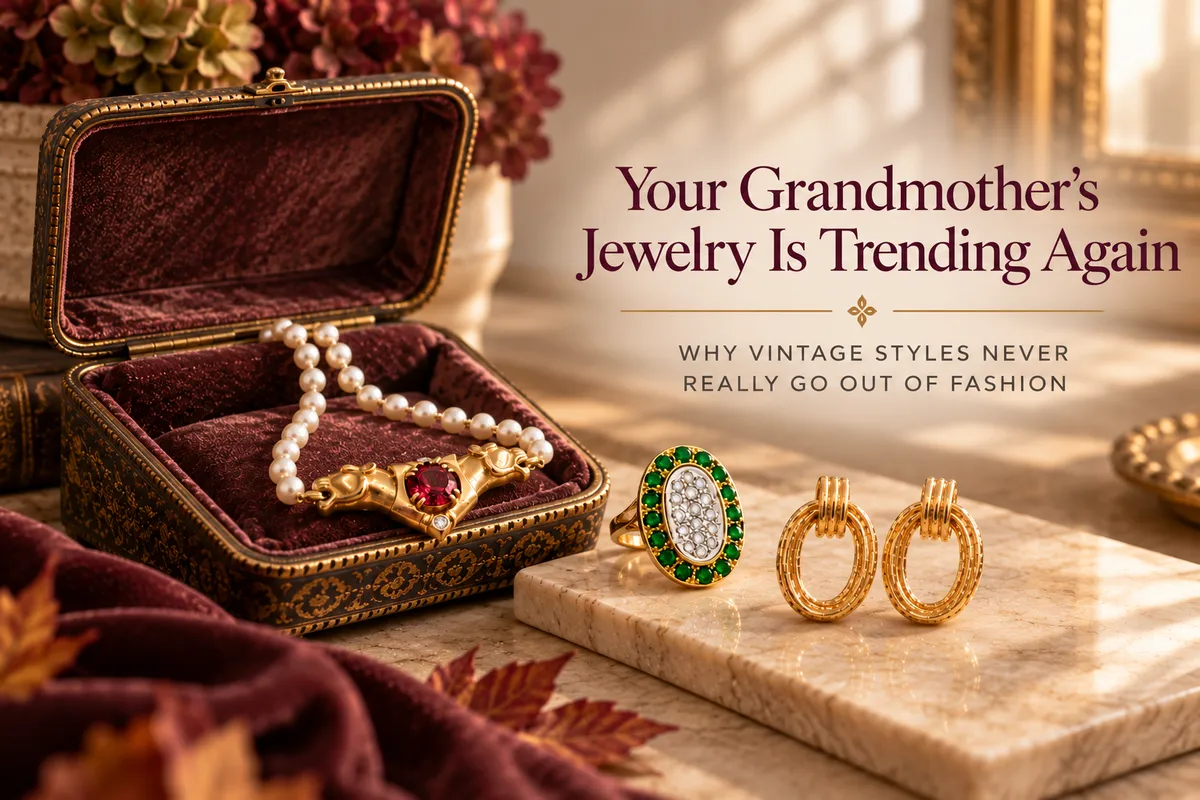
From timeless pearls to bold gold rings, some of today's most loved jewelry styles have been around longer than you might think!
You know that beautiful gold ring your grandmother wore every day? Or the pearl necklace that's been sitting in your mother's jewelry box for years?
Well, it might be time to give those pieces another look!
Fashion has a funny way of coming full circle, and jewelry is no exception. Styles that were popular decades ago are finding their way back into everyday wardrobes, engagement ring designs, and jewelry collections.
But here's what we find especially interesting: Many of the jewelry styles we consider modern aren't actually new at all. They're inspired by designs that have been loved for generations.
So, whether you're someone who treasures family heirlooms or someone who simply loves the character of vintage-inspired jewelry, let's take a little trip through jewelry history. You might be surprised by how much of the past is hiding in today's styles!
According to the Gemological Institute of America (GIA):
Antique jewelry is generally jewelry that's at least 100 years old.
Vintage jewelry typically refers to pieces that are around 20–30 years old or older, but not yet considered antique.
Estate jewelry simply means jewelry that has been previously owned, regardless of its age.
Here's a fun example: A ring purchased in the 1980s could be considered vintage today, while a ring made in the early 1900s may qualify as antique.
And just because a piece looks old doesn't necessarily mean it is! Many newly manufactured pieces are intentionally designed to resemble jewelry from earlier eras. These are called vintage-inspired or antique-style pieces.
But yellow gold's popularity is hardly a new development.
Gold has been treasured for thousands of years, and its role in jewelry has evolved alongside fashion, culture, and craftsmanship.
One particularly interesting period was the 1940s.
According to GIA's research on historical jewelry design, platinum became less available for jewelry manufacturing during World War II because of its importance to the war effort. As a result, gold and rose gold became especially prominent in jewelry from this era.
Designers embraced bold shapes, substantial metalwork, and eye-catching designs.
Sound familiar?
Today, those same characteristics can be seen in chunky gold rings, statement earrings, bold bracelets, and layered necklaces.
Our favorite thing about yellow gold? It doesn't need to belong to any particular decade. A beautiful gold chain purchased 40 years ago can look just as lovely with today's wardrobe.
Sometimes the most fashionable thing you can wear is something you've already owned for years.
Signet rings weren't originally just decorative accessories. They served an important purpose.
In ancient civilizations, engraved rings were used to leave impressions in wax or clay, helping identify the person associated with a document or object.
According to GIA, ancient Egyptians created rings with rotating elements that could feature engraved designs, including signets. Ancient Romans also used carved gemstone signet rings to seal important documents.
In other words, a ring could function almost like a personal signature!
Over time, signet rings became associated with family identity, tradition, and personal style.
Today, you don't need a family crest or an important document to enjoy one.
Signet rings can be worn as simple polished gold bands, engraved with initials, or personalized with meaningful symbols.
They're a wonderful example of how something once designed for a practical purpose can become a timeless piece of personal expression.
And we love that they're no longer limited to one particular style or gender.
For generations, pearls have been associated with elegance, sophistication, and important occasions.
But their history goes much further back than the classic pearl necklaces many of us remember our grandmothers wearing.
According to GIA, one of the earliest written references to natural pearls dates all the way back to 2206 BC in China!
That's more than 4,000 years of pearl appreciation.
For centuries, natural pearls were treasured by royalty and wealthy families. Their rarity made them symbols of status and luxury.
The development of commercially successful cultured pearls in the early 20th century eventually helped make pearl jewelry more accessible.
Today, pearls can be styled in countless ways.
A classic pearl necklace looks beautiful with formal attire, but it can be equally charming paired with a simple sweater or casual blouse. Pearl earrings can complement almost any outfit, and modern pearl designs can feel playful, artistic, or understated.
That's what makes pearls so special.
They can be traditional without feeling outdated.
One thing to remember: Pearls are softer and more delicate than many other gemstones. If you've inherited a pearl necklace, it's worth having the strand and clasp examined before wearing it regularly.
A little care can help preserve those beautiful pieces for another generation.
And when we look back at jewelry history, it's easy to understand why these designs continue to capture people's attention.
Two particularly influential periods were the Edwardian and Art Deco eras.
The Edwardian Era: Delicate and Romantic
During the early 1900s, Edwardian jewelry often featured intricate details, delicate metalwork, diamonds, pearls, and platinum.
GIA describes the era as one known for elegant, symmetrical designs and decorative motifs such as garlands and wreaths.
Think graceful shapes, fine details, and an almost lace-like appearance.
These design elements continue to inspire engagement rings today, particularly for those who appreciate a romantic, delicate look.
The Art Deco Era: Bold and Geometric
Now, jump ahead to the 1920s and 1930s.
Jewelry took a very different direction!
Art Deco designs embraced geometric patterns, symmetry, strong lines, and contrasting colors.
According to GIA, combinations such as diamonds with black onyx, sapphires, rubies, or emeralds were characteristic of this period.
Instead of soft, flowing details, Art Deco jewelry often featured striking shapes and structured designs.
And here's what's so interesting: Both of these very different styles can still feel beautiful and relevant today.
Whether someone loves delicate antique-inspired details or bold geometric designs, there's a piece of jewelry history that speaks to their personal taste.
But there's another reason older jewelry is so special.
It carries stories.
Maybe it's the wedding band your grandfather wore for 50 years.
Maybe it's a necklace your mother received for her graduation.
Or maybe it's a ring that has been passed down through several generations, with each owner adding another chapter to its history.
Those memories are something you simply can't manufacture.
And while jewelry styles may change, the sentimental value of a meaningful piece often grows with time.
That's why we always encourage customers to think carefully before parting with older jewelry.
Even if a piece isn't something you would choose to wear today, it may have possibilities you haven't considered.
Which brings us to one of our favorite conversations to have with customers...
You've inherited a beautiful piece of jewelry from someone you love, but it doesn't quite fit your personal style.
Maybe the ring is too large, the setting feels outdated, or the necklace simply isn't something you would wear.
And now you're torn.
You want to honor the person who gave it to you, but you also want to enjoy wearing it.
The good news? You may have options!
Depending on the piece, a jeweler may be able to resize it, repair it, restore worn components, or even incorporate its gemstones into a completely new design.
For example, a gemstone from an inherited ring might become the centerpiece of a pendant. Or diamonds from an older mounting could be incorporated into a new ring that better reflects your style.
However, not every piece is a good candidate for redesign.
Some antique settings are fragile, certain gemstones require special handling, and alterations can affect the historical character or value of a piece.
Before making permanent changes, it's important to have the jewelry professionally evaluated.
And remember, there's absolutely nothing wrong with keeping a piece exactly as it is.
Sometimes preserving its original design is the most meaningful choice.
Other times, giving it a new purpose allows it to be worn and loved for years to come.
Neither choice is right for everyone, and that's okay!
But before slipping on a ring that's been tucked away for 20 years, there are a few things worth considering.
Even jewelry that hasn't been worn recently can have existing damage or weakened components.
GIA recommends carefully examining estate jewelry for issues such as missing gemstones, dents, deep scratches, and evidence of previous repairs.
At Parker's Karat Patch, we recommend bringing your jewelry in every six months for a professional inspection and cleaning.
During an inspection, we can check important areas such as prongs, stone security, clasps, and the overall condition of your piece.
We also recommend having inherited or long-stored jewelry inspected before returning it to regular wear.
And while we're big believers that jewelry is meant to be worn and enjoyed, we also believe that a little preventive maintenance goes a long way.
After all, we'd much rather help you address a loose prong today than have you discover a missing gemstone tomorrow!
The Best Jewelry Never Really Goes Out of Style
As the seasons change and we pull out our favorite fall sweaters, jackets, and accessories, it's the perfect time to take another look at the jewelry we already own.
Maybe there's a gold bracelet you've forgotten about.
Maybe your grandmother's pearls deserve an afternoon out.
Or maybe that vintage ring you've always admired is ready to become part of your everyday collection.
The wonderful thing about jewelry is that it doesn't have to follow every new trend to be beautiful.
Some pieces are loved because they're fashionable.
Others are loved because they're meaningful.
And the very best pieces? They're often a little bit of both.
At Parker's Karat Patch, we believe jewelry should be worn, enjoyed, and cherished—whether it's brand new or has been in your family for generations.
If you have an older piece you're curious about, we'd love to take a look with you. Whether you're interested in restoring something special, exploring redesign possibilities, or simply making sure an heirloom is safe to wear, we're always happy to help.
Because sometimes, the most beautiful thing in your jewelry box isn't something new.
It's something that has been waiting to be loved all over again.
With love and a little sparkle,
Your Friends at Parker's Karat Patch
You know that beautiful gold ring your grandmother wore every day? Or the pearl necklace that's been sitting in your mother's jewelry box for years?
Well, it might be time to give those pieces another look!
Fashion has a funny way of coming full circle, and jewelry is no exception. Styles that were popular decades ago are finding their way back into everyday wardrobes, engagement ring designs, and jewelry collections.
But here's what we find especially interesting: Many of the jewelry styles we consider modern aren't actually new at all. They're inspired by designs that have been loved for generations.
So, whether you're someone who treasures family heirlooms or someone who simply loves the character of vintage-inspired jewelry, let's take a little trip through jewelry history. You might be surprised by how much of the past is hiding in today's styles!
First Things First: What's the Difference Between Vintage, Antique, and Estate Jewelry?
These three terms are often used interchangeably, but they actually mean different things.According to the Gemological Institute of America (GIA):
Antique jewelry is generally jewelry that's at least 100 years old.
Vintage jewelry typically refers to pieces that are around 20–30 years old or older, but not yet considered antique.
Estate jewelry simply means jewelry that has been previously owned, regardless of its age.
Here's a fun example: A ring purchased in the 1980s could be considered vintage today, while a ring made in the early 1900s may qualify as antique.
And just because a piece looks old doesn't necessarily mean it is! Many newly manufactured pieces are intentionally designed to resemble jewelry from earlier eras. These are called vintage-inspired or antique-style pieces.
1. Yellow Gold: A Classic That Keeps Coming Back
If you've noticed more yellow gold jewelry being worn lately, you're certainly not alone in appreciating its warm, timeless appearance.But yellow gold's popularity is hardly a new development.
Gold has been treasured for thousands of years, and its role in jewelry has evolved alongside fashion, culture, and craftsmanship.
One particularly interesting period was the 1940s.
According to GIA's research on historical jewelry design, platinum became less available for jewelry manufacturing during World War II because of its importance to the war effort. As a result, gold and rose gold became especially prominent in jewelry from this era.
Designers embraced bold shapes, substantial metalwork, and eye-catching designs.
Sound familiar?
Today, those same characteristics can be seen in chunky gold rings, statement earrings, bold bracelets, and layered necklaces.
Our favorite thing about yellow gold? It doesn't need to belong to any particular decade. A beautiful gold chain purchased 40 years ago can look just as lovely with today's wardrobe.
Sometimes the most fashionable thing you can wear is something you've already owned for years.
2. Signet Rings: From Ancient History to Everyday Fashion
Here's a piece of jewelry with a surprisingly fascinating history!Signet rings weren't originally just decorative accessories. They served an important purpose.
In ancient civilizations, engraved rings were used to leave impressions in wax or clay, helping identify the person associated with a document or object.
According to GIA, ancient Egyptians created rings with rotating elements that could feature engraved designs, including signets. Ancient Romans also used carved gemstone signet rings to seal important documents.
In other words, a ring could function almost like a personal signature!
Over time, signet rings became associated with family identity, tradition, and personal style.
Today, you don't need a family crest or an important document to enjoy one.
Signet rings can be worn as simple polished gold bands, engraved with initials, or personalized with meaningful symbols.
They're a wonderful example of how something once designed for a practical purpose can become a timeless piece of personal expression.
And we love that they're no longer limited to one particular style or gender.
3. Pearls: Definitely Not Just for Special Occasions
Let's talk about pearls!For generations, pearls have been associated with elegance, sophistication, and important occasions.
But their history goes much further back than the classic pearl necklaces many of us remember our grandmothers wearing.
According to GIA, one of the earliest written references to natural pearls dates all the way back to 2206 BC in China!
That's more than 4,000 years of pearl appreciation.
For centuries, natural pearls were treasured by royalty and wealthy families. Their rarity made them symbols of status and luxury.
The development of commercially successful cultured pearls in the early 20th century eventually helped make pearl jewelry more accessible.
Today, pearls can be styled in countless ways.
A classic pearl necklace looks beautiful with formal attire, but it can be equally charming paired with a simple sweater or casual blouse. Pearl earrings can complement almost any outfit, and modern pearl designs can feel playful, artistic, or understated.
That's what makes pearls so special.
They can be traditional without feeling outdated.
One thing to remember: Pearls are softer and more delicate than many other gemstones. If you've inherited a pearl necklace, it's worth having the strand and clasp examined before wearing it regularly.
A little care can help preserve those beautiful pieces for another generation.
4. Vintage Engagement Rings: Old-Fashioned Romance, Timeless Beauty
There's something undeniably romantic about an engagement ring inspired by another era.And when we look back at jewelry history, it's easy to understand why these designs continue to capture people's attention.
Two particularly influential periods were the Edwardian and Art Deco eras.
The Edwardian Era: Delicate and Romantic
During the early 1900s, Edwardian jewelry often featured intricate details, delicate metalwork, diamonds, pearls, and platinum.
GIA describes the era as one known for elegant, symmetrical designs and decorative motifs such as garlands and wreaths.
Think graceful shapes, fine details, and an almost lace-like appearance.
These design elements continue to inspire engagement rings today, particularly for those who appreciate a romantic, delicate look.
The Art Deco Era: Bold and Geometric
Now, jump ahead to the 1920s and 1930s.
Jewelry took a very different direction!
Art Deco designs embraced geometric patterns, symmetry, strong lines, and contrasting colors.
According to GIA, combinations such as diamonds with black onyx, sapphires, rubies, or emeralds were characteristic of this period.
Instead of soft, flowing details, Art Deco jewelry often featured striking shapes and structured designs.
And here's what's so interesting: Both of these very different styles can still feel beautiful and relevant today.
Whether someone loves delicate antique-inspired details or bold geometric designs, there's a piece of jewelry history that speaks to their personal taste.
5. The Most Beautiful Part of Vintage Jewelry Isn't Always What You Can See
We can talk about gold, gemstones, and design trends all day long.But there's another reason older jewelry is so special.
It carries stories.
Maybe it's the wedding band your grandfather wore for 50 years.
Maybe it's a necklace your mother received for her graduation.
Or maybe it's a ring that has been passed down through several generations, with each owner adding another chapter to its history.
Those memories are something you simply can't manufacture.
And while jewelry styles may change, the sentimental value of a meaningful piece often grows with time.
That's why we always encourage customers to think carefully before parting with older jewelry.
Even if a piece isn't something you would choose to wear today, it may have possibilities you haven't considered.
Which brings us to one of our favorite conversations to have with customers...
6. What If You Love the Sentiment but Not the Style?
Here's a situation we see often:You've inherited a beautiful piece of jewelry from someone you love, but it doesn't quite fit your personal style.
Maybe the ring is too large, the setting feels outdated, or the necklace simply isn't something you would wear.
And now you're torn.
You want to honor the person who gave it to you, but you also want to enjoy wearing it.
The good news? You may have options!
Depending on the piece, a jeweler may be able to resize it, repair it, restore worn components, or even incorporate its gemstones into a completely new design.
For example, a gemstone from an inherited ring might become the centerpiece of a pendant. Or diamonds from an older mounting could be incorporated into a new ring that better reflects your style.
However, not every piece is a good candidate for redesign.
Some antique settings are fragile, certain gemstones require special handling, and alterations can affect the historical character or value of a piece.
Before making permanent changes, it's important to have the jewelry professionally evaluated.
And remember, there's absolutely nothing wrong with keeping a piece exactly as it is.
Sometimes preserving its original design is the most meaningful choice.
Other times, giving it a new purpose allows it to be worn and loved for years to come.
Neither choice is right for everyone, and that's okay!
7. Before You Wear That Heirloom, Give It a Little Attention
If this article has inspired you to dig through your jewelry box, we love that!But before slipping on a ring that's been tucked away for 20 years, there are a few things worth considering.
Even jewelry that hasn't been worn recently can have existing damage or weakened components.
GIA recommends carefully examining estate jewelry for issues such as missing gemstones, dents, deep scratches, and evidence of previous repairs.
At Parker's Karat Patch, we recommend bringing your jewelry in every six months for a professional inspection and cleaning.
During an inspection, we can check important areas such as prongs, stone security, clasps, and the overall condition of your piece.
We also recommend having inherited or long-stored jewelry inspected before returning it to regular wear.
And while we're big believers that jewelry is meant to be worn and enjoyed, we also believe that a little preventive maintenance goes a long way.
After all, we'd much rather help you address a loose prong today than have you discover a missing gemstone tomorrow!
The Best Jewelry Never Really Goes Out of Style
As the seasons change and we pull out our favorite fall sweaters, jackets, and accessories, it's the perfect time to take another look at the jewelry we already own.
Maybe there's a gold bracelet you've forgotten about.
Maybe your grandmother's pearls deserve an afternoon out.
Or maybe that vintage ring you've always admired is ready to become part of your everyday collection.
The wonderful thing about jewelry is that it doesn't have to follow every new trend to be beautiful.
Some pieces are loved because they're fashionable.
Others are loved because they're meaningful.
And the very best pieces? They're often a little bit of both.
At Parker's Karat Patch, we believe jewelry should be worn, enjoyed, and cherished—whether it's brand new or has been in your family for generations.
If you have an older piece you're curious about, we'd love to take a look with you. Whether you're interested in restoring something special, exploring redesign possibilities, or simply making sure an heirloom is safe to wear, we're always happy to help.
Because sometimes, the most beautiful thing in your jewelry box isn't something new.
It's something that has been waiting to be loved all over again.
With love and a little sparkle,
Your Friends at Parker's Karat Patch